So you’ve got your first real humidor. Maybe you bought it, maybe it showed up with a bow on it. Either way, here’s the most important thing we can tell you: it isn’t ready yet. A new humidor arrives dry, and the most common mistake new owners make is loading it the same day it shows up. Give it a few days of setup and it will take care of your cigars for years. Skip that step and it will quietly pull the moisture right out of them.
We may earn a commission if you buy through our link.
Below, we walk through what a first humidor needs, use a real box as a worked example, and lay out the seasoning steps from a field guide we trust. Let’s get it right the first time.
Why a new humidor isn’t ready on day one
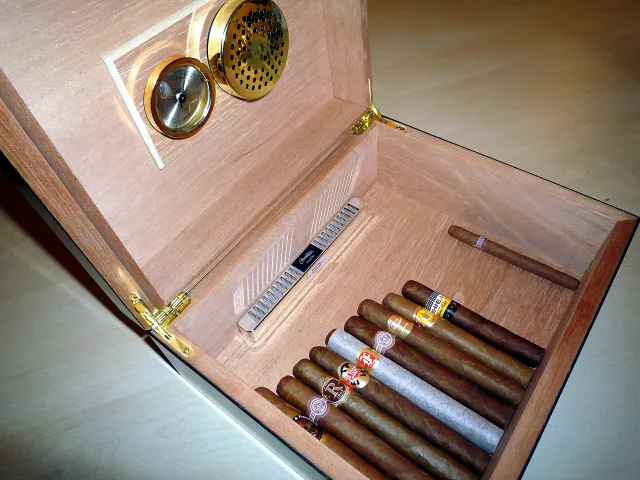
A humidor is lined with Spanish cedar, and fresh cedar is thirsty. Straight out of the box, the wood is dry. If you put cigars in before the wood has been brought up to humidity, the cedar takes moisture from the cigars instead of holding it for them.
Seasoning fixes that. As Barrister & Bespoke’s field guide explains, seasoning brings the cedar up to humidity so it stops taking moisture from your cigars and starts holding it. The wood swells slightly as it absorbs water, which also helps tighten the seal between the lid and the box.
That’s why patience on day one pays off for the life of the humidor.
What a working first box actually needs
You don’t need a fancy box to store cigars well, but a good first humidor does need a few things:
- The right capacity. Choose a box sized for the cigars you already keep, with a little room to grow. Remember that most humidors are rated in coronas, so a box holds fewer cigars once bigger ring gauges go in.
- Real Spanish cedar. Cedar holds and releases moisture, and it’s the working surface of the whole box.
- A humidifier you can charge with distilled water. Most humidors come with one mounted in the lid.
- A hygrometer you can trust. A gauge you haven’t tested is just a guess. More on that below.
- A lid that seals. The fit between the lid and the box is what holds the climate.
A worked example: the Daniel Marshall Ambiente 65
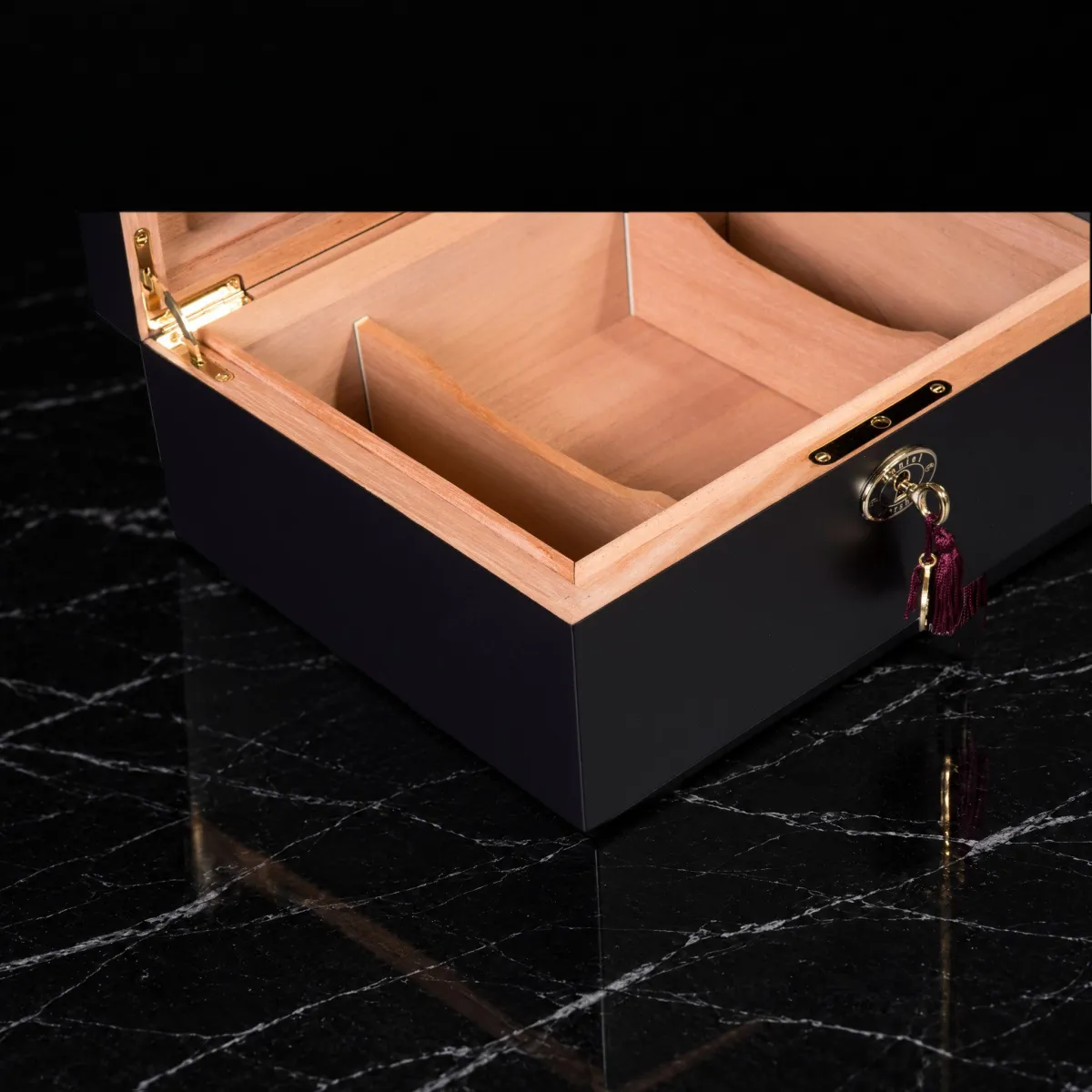
To make this concrete, we’ll use the Daniel Marshall Ambiente 65 as our example. It’s the kind of box people buy when they want their first serious humidor to also be their last. Here’s what Barrister & Bespoke’s listing says about it:
- Hand-built in the United States, at a California workshop that has been making humidors since 1982
- Capacity of 65 cigars, rated at corona size
- Spanish cedar interior with two movable cedar dividers
- 24-karat gold-plated hinges, lock and key
- Digital hygrometer and Daniel Marshall humidification system included
- Black matte lacquer finish, with an authenticity card
- 11″ W x 8 1/2″ D x 4 1/2″ H
That capacity figure deserves a closer look. The 65 on the label is a corona count. Daniel Marshall puts this box at about 45 to 50 cigars once larger ring gauges go in. That’s a solid working collection, but it’s worth knowing before you plan around the number on the label.
Whatever box you have, the setup process below is the same.
The seasoning protocol
For the full how-to, we point you to Barrister & Bespoke’s humidor seasoning field guide, Season It, or Ruin It? Here’s the protocol as the guide lays it out:
- Pick the spot first. Set the humidor on a flat surface where you plan to keep it, away from outside walls, air vents and direct sun. Moving it later means it has to adjust all over again.
- Wipe the cedar. Dampen a clean, lint-free cloth with distilled water and wipe every interior surface: walls, floor, the underside of the lid and both sides of any divider. Damp, never wet. If water beads up, you’ve used too much.
- Charge the humidifier. Take it out of the lid and soak it in distilled water for two to three minutes. Blot the outside dry and put it back. A dripping humidifier can stain the cedar.
- Close it over water. Set a small, shallow open dish of distilled water inside, close the lid and leave it alone for three to five days. Don’t keep opening it to check. The guide says every opening resets the process and adds a day.
- Let it settle. Take the dish out. The reading will be high at first, typically 75% to 85%, and the guide says that’s expected. Close the lid and give it two to three days to settle until it holds steadily between 65% and 72% relative humidity, at 65 to 70°F.
- Check your gauge. Calibrate the hygrometer with the salt test. Seal it in a zip-top bag with a bottle cap of table salt dampened with a few drops of distilled water, keeping them from touching, and leave it for 24 hours. A saturated salt solution holds the air at 75%, so a correct gauge reads 75%. Any difference is your offset.
If the reading settles below the band, the guide says to close it over water for another two days. If it settles above 72%, take the humidifier out, close the lid and check again the next day.
Where the product page and the field guide differ on timing
Here’s something worth pointing out. Barrister & Bespoke’s two sources give different timing for the dish step.
- The Ambiente 65 product page describes closing the humidor over a small dish of distilled water for 48 to 72 hours, then confirming the hygrometer holds steadily between 65% and 72% before loading cigars.
- The seasoning field guide describes three to five days over the dish, followed by two to three days to settle.
We’re not going to split the difference or invent a timeline of our own. Both sources agree on what matters most: distilled water, patience, and a steady reading between 65% and 72% before any cigars go in. Follow one source’s steps all the way through, and let the hygrometer, not the calendar, tell you when you’re done. If you’re unsure, the field guide is the more detailed of the two.
Loading gradually, then holding the climate
Once the reading holds, it’s time to load. The field guide recommends bringing cigars in over several days instead of filling the box all at once. A full load of drier cigars can pull the humidity down faster than the humidifier can recover. Load your cigars gradually once the climate holds.
The guide also suggests waiting two weeks after adding your last cigars before trusting the reading, since the cigars and the wood are still adjusting to each other. The Ambiente 65 product page makes a similar point about giving the hygrometer two calibrated weeks before you trust it.
After that, it’s maintenance. The field guide’s rhythm:
- Recharge the humidifier every two to four weeks, sooner in heated or air-conditioned rooms.
- Calibrate the hygrometer before first use, then twice a year.
- Rotate cigars from top to bottom every few months.
- Open the lid deliberately, since every opening resets the climate.
The guide also makes a point we love: stability beats precision. A humidor that sits at a steady 66% all year treats cigars better than one swinging between 60% and 75%.
What not to do
The field guide calls out a handful of common mistakes. Every one of them is easy to avoid:
- Tap water. Use distilled water only. Tap water carries minerals that clog the humidifier and leave white deposits on the cedar. The guide says filtered and spring water aren’t substitutes either.
- The wet-sponge method. Don’t soak the cedar by wiping it down with a dripping sponge. The guide warns that soaking raw cedar warps it.
- Sanding the cedar. Leave the wood alone. No sanding.
- Trusting an untested gauge. The guide notes that most analog hygrometers ship uncalibrated and can read five points or more off. Do the salt test.
- Over-humidifying. More isn’t better. Above about 72%, the guide says cigars can swell, draw tight, burn unevenly and become vulnerable to mold.
And if the box still won’t hold after a full week, the guide says you’re likely looking at a seal problem rather than a seasoning problem. It covers the dollar bill test for checking the seal, but only run it on a box that’s already been seasoned.
Ready to set yours up?
A first humidor is one of the smartest upgrades a cigar smoker can make, as long as it gets a proper start. Season it, calibrate the gauge, load it slowly and keep the climate steady.
If you’re still shopping for your first box, take a look at the Daniel Marshall Ambiente 65. If you’re giving one as a gift, our holiday gift guide for cigar smokers has a few ideas to pair with it. For the full protocol, keep Season It, or Ruin It? bookmarked. And for more cigar talk, check out our video podcasts.