Guillotine vs. V-Cut vs. Punch: Which Cigar Cutter Is Right for You?
Before the first puff, before the toast, before the light, there’s the cut. And unlike almost everything else in the ritual, you don’t get a do-over. Cut too deep and the wrapper can start to unravel. Crush the cap and you’re fighting a tight draw for the next hour. So it’s worth knowing what each style of cut actually does, and then picking a tool that does it cleanly.
We may earn a commission if you buy through our link.
Below, we break down the three main cuts: guillotine, V-cut and punch. Then we look at one everyday cutter as a starting point, and send you to a field guide that compares eight cutters side by side.
Why the cut matters more than people think
The cap is the small round piece of wrapper leaf that seals the head of the cigar. Your cut opens it up so smoke can flow. Do it well and the draw is easy and even. Do it badly and you can crush the head, tear the wrapper or open it too wide.
As Barrister & Bespoke puts it on its Xi1 listing, a crushed cap means a tight draw for the whole cigar. That’s a rough way to spend a good smoke.
Our old Cigar University lesson on how to cut and light a cigar still holds up: don’t go too low. You want to cut just above where the cap ends, then test the draw before you light. If it’s still tight, you can take a little more off. You can’t put it back.
Guillotine
The guillotine is the straight cut. It slices straight across the cap and takes the top off, opening the full face of the head. According to Barrister & Bespoke’s cutter field guide, it’s the cut most of the dedicated cutters they carry are built for.
Guillotines come in two main styles:
- Single blade. One blade moves across the cigar. The risk, as Barrister & Bespoke explains, is that a single blade can push the cigar ahead of it and crush the cap.
- Double guillotine. Two blades close from opposite sides and meet in the middle, instead of one blade dragging across the wrapper. That’s why a lot of smokers prefer it for a clean, even cut.
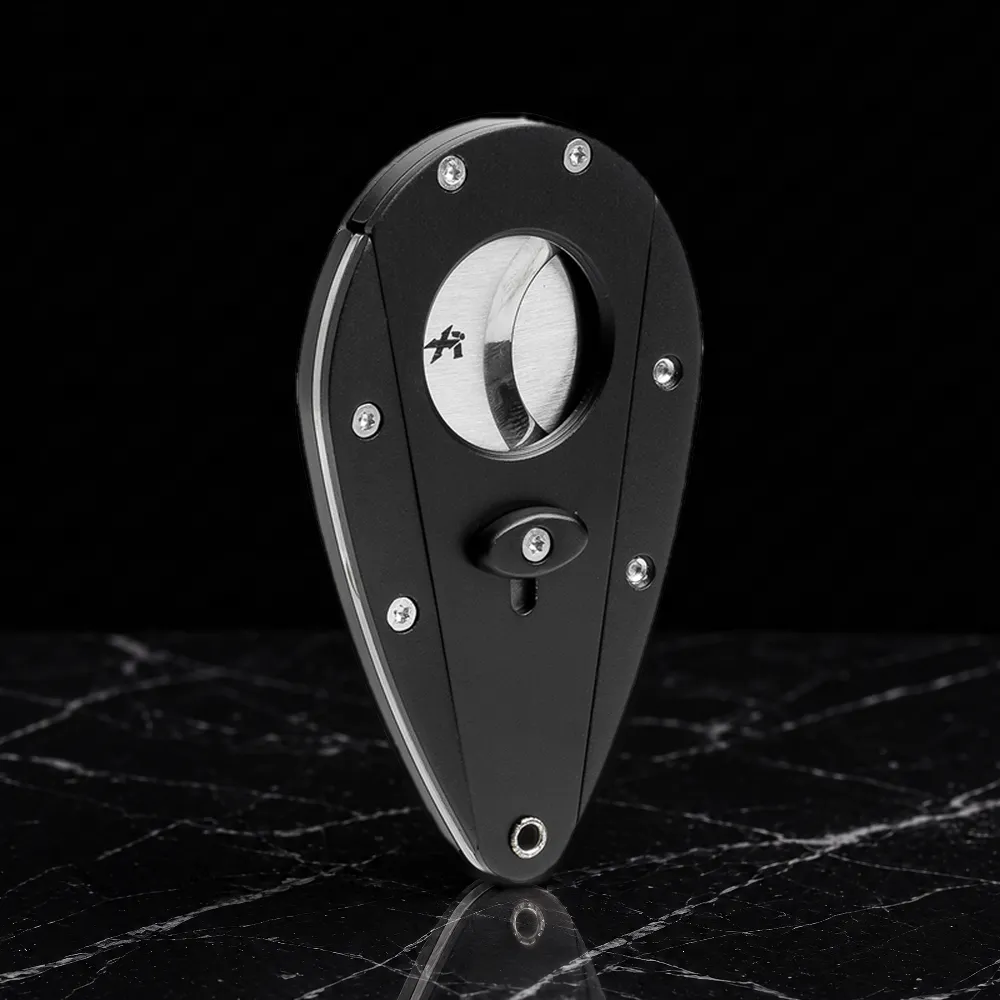
If you want a pocket double guillotine to start with, the Xikar Xi1 is the example we’ll come back to below.
Technique matters as much as the tool. Line up the blade just above the shoulder where the cap meets the body, then close it in one firm, confident motion. Barrister & Bespoke describes the Xi1’s two blades closing “in a single squeeze,” and that’s the idea with any guillotine. Hesitate halfway and you’re more likely to tear the wrapper.
The guillotine is a good all-rounder. It works on most shapes and sizes, and it gives you the most open draw of the three cuts.
V-cut
The V-cut opens a wedge into the cap instead of taking the top off or punching a hole. The result is a deeper notch that leaves more of the cap in place than a straight cut.
Barrister & Bespoke’s field guide notes that the shop carries the V-cut in one instrument, the Xceed, which pairs a 23 mm V-cut with 8 mm and 10 mm punches. The guide is clear that the Xceed doesn’t make a straight guillotine cut, so it’s a tool for people who already know they like the V.
Some smokers like how a V-cut concentrates the draw. Others find it too much work. It’s a matter of taste, so try one before you commit.
Punch
A punch bores a small circle through the cap and leaves the rest of it in place. According to the field guide, people who prefer it often want a narrower draw than a full slice, or a smaller opening on a wrapper they’d rather not take the top off.
Punches are small, simple and easy to keep on a keychain. They come in different diameters, and the size of the hole affects how open the draw feels. A punch isn’t the right tool for every shape, though. On a pointed head, like a torpedo or a belicoso, a straight cut usually makes more sense.
How to read ring gauge, and why a published capacity is not a promise
Every cutter has a capacity, and every cigar has a ring gauge. Matching them takes a little understanding.
Ring gauge measures the cigar’s diameter at its widest point, in 64ths of an inch. A 64 ring gauge cigar is one inch across. A 50 is 50/64ths of an inch.
Here’s the catch, and Barrister & Bespoke’s cutter field guide explains it well. A published cutter capacity is the maker’s stated range, not a guarantee that every cigar of that number will seat the same way. The head of a cigar tapers, so the part you actually cut is often narrower than the body. Use the published figure as a guide, and don’t treat the body’s ring gauge as an exact match for the hole in the tool.
The Xi1 is a good example of why this matters. Barrister & Bespoke’s listing says it cuts a 54 ring gauge in half, up to 60 depending on the cap. Xikar’s own Xi1 page, as cited in the field guide, gives 54, up to 64. Two official sources, two figures. If you regularly smoke very large ring gauges, measure before you buy, and read both numbers with that taper in mind.
A pocket double guillotine to start with: the Xikar Xi1
If you’re after one straight-cut tool for everyday carry, the Xikar Xi1 is a solid place to start. The field guide notes it’s the cutter named in the starter kit in James Kaywell’s own essay on the ritual. Here’s what Barrister & Bespoke’s listing says:
- Patented double guillotine action
- 440C stainless steel blades, hardened to Rockwell 57
- Anodized aluminum body, in an ergonomic teardrop shape
- Spring-loaded, and locks closed for safety
- Cuts a 54 ring gauge in half; up to 60 depending on the cap (B&B’s listing)
- Phantom Black: black body, black blades
The listing calls 440C a cutlery-grade steel, at a hardness meant to hold an edge. Because it locks closed, it won’t open up in a jacket pocket next to your phone and keys. Xikar covers it with a limited lifetime warranty against manufacturing defects.
One more fun fact from the field guide: Xikar’s Xi cutter shape earned trade-dress protection from the U.S. Patent and Trademark Office in 2014, meaning the shape itself is a trademark.
Further reading: James Kaywell’s field guide to eight cutters
We kept this piece focused on the three cuts and one everyday tool. If you want the full comparison, Barrister & Bespoke founder James Kaywell’s Guillotine, V-Cut or Punch field guide lines up eight cutters from the shop’s shelves by the cut each one makes, the capacity published for each and what else each is built to do. It’s a thorough read if you’re deciding between a double guillotine, a geared cutter, a V-cut or a dual-wing design.
Here’s a quick cheat sheet while you decide:
- Want the most open draw and a tool that handles most shapes? Go guillotine, ideally a double.
- Like a focused draw and leaving more of the cap intact? Try a V-cut.
- Want something tiny for the keychain and a narrower draw? A punch is the simple answer.
- Not sure yet? Start with a double guillotine. It’s the most forgiving place to learn, and you can add a punch or V-cut later.
There’s no single right answer here. Pick the cut that gives you the draw you like, then pick a tool that makes it cleanly. Pair it with the right flame using our guide to torch vs. soft flame lighters, and if you’re shopping for someone else, our holiday gift guide for cigar smokers has a few more ideas.